Get the Ultimate Golf Simulator Comparison Tool

Get the Ultimate Golf Simulator Comparison Tool

Monday, December 10, 2018

First Look: Wilson Staff D7 Irons

What would you say is the key difference between a Super Game Improvement iron and an iron in the emerging Players Distance category?

First, let’s look at the similarities. The SGI category promises forgiveness and distance for straighter, longer shots. Workability, of course, isn’t part of the equation. Players Distance promises distance and forgiveness for longer, straighter shots, with enough potential workability to make a better player swoon.

Seeing any common threads?

Put the two irons side-by-side and the biggest difference is obvious: one looks sleek, simple and, dare I say, sexy — the other looks like what better players disdainfully refer to as a shovel, with more bling than that one crazy aunt everyone has.

With today’s release of its new D7 irons, Wilson Staff is trying to bridge the gap between those two categories – by combining distance and forgiveness the SGI player needs with the clean looks a better player wants.

It’s a neat trick, but can that gap be bridged, or is it a bridge too far?

Meet The D7

There’s plenty of performance tech to talk about with the D7, but the most startling difference is its looks. D7 bears little, if any, resemblance to the 2-year-old D300, which it’s replacing.

“We have a strong history of what I’d call very bold and very red design elements,” says Wilson Golf Club Innovation Manager Jon Pergande. “Bold features denote forgiveness, but also chunkiness, with a heavy dose of red accents.”

The first thing you notice about the new D7 is the absence of bling. The second is an absence of red. Compared to its predecessor, D7 looks sleek, simple and sexy. The flashy red cavity decoration is gone, replaced with simple black and chrome, with a whisper of blue.

“The blue cools things off and makes it look a bit sleeker,” says Pergande. “But that sleekness is tied into the design. The D300 was very abrupt, with large features in the back, with Power Holes visible on the top line.”

The goal, says Pergande, was to create a cleaner, classier looking distance iron that could appeal to that Players Distance golfer looking for a little more forgiveness.

“We started by looking at the V6 and C300 Forged irons, products we’ve had great success with, and tried to work more of a traditional looking aesthetic,” he says. “So we’re losing the Power Holes on the topline and opening up the cavity a little bit to increase the MOI.”

Ahh, the Power Holes. From an aesthetic viewpoint, folks either ignore them, find them mildly irritating or loathe them entirely. Regardless, they’re gone from D7’s top line but are still used on the sole. There’s a Power Hole performance/tech story to be told, but at least half the D7 story is about curb appeal. Wilson wants it to wink at you from across the room.

Pick Me, Pick Me!

Even though the data says there’s no real correlation between looks and performance, when it comes to grabbing something off the shelf and giving it a whack or two on the launch monitor, we do like that eye candy.

“We’re trying to improve the initial consumer experience at the point of purchase, prior to testing,” says Pergande. “Part of that experience is a very clean shape. We wanted to keep the shape as clean as possible and hide the robustness and forgiveness for that better player’s eye.”

In that respect, Wilson’s done a pretty decent job. The D7 may not be the Kate Upton of irons, but it’s no Mimi from the Drew Carey Show, either. Getting rid of the top line Power Holes helps immensely. For an SGI iron the top line isn’t bad at all (a side-by-side comparison with the C300 Forged is below) and Wilson has done a nice job hiding the offset.

“The transition of hosel to leading edge is always tricky,” says Pergande. “These are distance clubs, and you want to have offset. It helps, especially in the longer irons. But as long as you transition the blends, you can hide the offset, and as long as you camber the topline a little, you can hide that width.”

“We think the market is shifting away from super-forgiveness looking and super chunky looking, and has moved into this much cleaner, more traditional look. I don’t want to associate D7 with a purely traditional look – it still has a large blade. But there are a lot of design cues that may improve the experiences for the better player, and maybe give him or her some added distance they may need for their game.” – Jon Pergande, Wilson Golf

The D7’s styling fits in nicely in Wilson’s iron continuum, with a family resemblance to the C300, C300 Forged, and FG Tour V6 (and maybe those sweet looking new blades), as well as the Super-Duper Game Improvement D350, for branding consistency, but with enough identity to stand on its own.

Putting the D in Distance

Wilson’s categorizes its iron sets as well as anyone in the business. D is for Distance, F (as in FG Tour V6 or FG Tour 100) is for Feel and C is for Crossover: more distance than the F’s, more feel than the D’s. Wilson’s very good at D, with both the D300 and D350 finishing at or near the top in both ball speed and carry distance in MyGolfSpy’s 2018 Most Wanted SGI iron test. Power Holes do their job.

Power Holes are Wilson’s way of creating more face-deflection, something virtually every iron-maker is doing in the quest for distance. The tech debuted in January of 2016 in the C200 iron, and Wilson has since added the technology to both the C and D series. The idea behind Power Holes? Disconnect the clubface from the head structure as much as possible, allowing the face to flex more at impact to maximize ball speed, no matter where on the face you hit it.

The top line Power Holes are gone, but Wilson is incorporating what it calls Progressive Power Hole technology on the sole, basically putting the power where you need it: three rows of Power Holes in the long irons (4-7), two rows in the 8- and 9-irons, and only one row in the Gap Wedge.

“Where do you need ball speed the most? For most players, it’s the long irons, the ones they struggle to hit the most,” says Pergande. “That’s where you need your distance advantage. People don’t need help hitting a pitching wedge farther. Besides, Power Holes don’t provide as much benefit on a more lofted club because the ball hits at such an angle.”

Previous Power Hole tech was known as FLX Face because Power Holes let the face flex. In the D7, however, Wilson is calling its ball speed tech something new: RE-AKT.

“It’s sort of an umbrella technology platform for the entire D7 series,” says Pergande. “Greater ball speed and higher MOI, so you get straighter shots that go farther. We also have the thinnest face we’ve ever had in an iron, and we do all that in a performance iron aesthetic.”

GIVEAWAY: The “Best Value” Rangefinder 2018!

Precision Pro NX7 PRO

Enter MyGolfSpy’s Giveaway!


The Battle of the 7-Irons

If more on-the-shelf sex appeal is one key element of the D7, winning the battle of the 7-irons is the other.

“We’re putting a stake in the ground. We want to win with the 7-iron,” says Pergande. “The definitive consumer experience for 90% or more of golfers is the 7-iron. That’s the one you have for demo clubs; it’s where custom fit is usually centered and, generally speaking, it’s one of the longer clubs most players can hit comfortably.”

“So if we can make sure we have the best possible 7-iron experience for the consumer at his first contact, we’re going to do all we can to make that happen.”

Wilson isn’t short-changing the other clubs at the expense of the 7-iron. The 4, 5 and 6 have the same tech, but they figure the confluence of curb appeal, performance, and the club D series players use most is at the 7.

And you do have to give Wilson some credit for straight talk. Pergande says you’ll find the D7 roughly 5 yards longer than D300, but adds half of that is due to a slightly stronger loft structure, which is actually now more in line with others in the SGI world.

“It varies by clubhead speed, but you usually get an extra two-and-a-half yards per degree of loft increase. The rest is coming from the Power Holes and the club’s forgiveness.”

From an MOI standpoint, Wilson says the D7 features a roughly 10% increase in MOI over the D300, largely due to a change in the back cavity. The D300s featured large pods in the back cavity, towards the toe and heel.

“Those pods weren’t 100% filled with weight, and they weren’t putting weight toward the extreme perimeter of the club,” says Pergande. “It made the club look more forgiving, even though it’s not the most efficient use of weight.”

With D7, Pergande says that weight has been shoved more heel-ward and more toe-ward.

“When it comes to forgiveness, size rules the roost. The larger the (iron head), the more forgiveness will be in there. But once you establish a head size, it’s all about weight management.”

Price, Availability and Final Thoughts

MyGolfSpy has long suggested golfers should consider using the most forgiving club you can stand to look at. Wilson seems to have taken that to heart by giving the D7 a makeover – swapping the loud sportcoat for a black tie and tails. And while Wilson is trying to suggest D7 would be at home in the Players Distance category, the sole is still SGI-wide, and the blade is still SGI-long. Wilson’s choice of stock steel shaft – the KBS Tour 80 – is still SGI-centric.

Wilson has taken heat for the $499 price tag on the Driver Vs. Driver winning Cortex, so it needs to be noted the D7 will retail at $599 in steel and $699 in graphite (UST Mamiya Recoil is stock). That’s a full $200 price drop from D300’s original retail.

After a couple of range sessions, we can say the D7 is a worthy successor to the D300 (again, an excellent ball speed/distance performer in Most Wanted). Could it realistically bridge the gap between SGI and Players Distance? Well, at $599, an upgrade to a C-Taper, DG or any other stronger player shaft wouldn’t break the bank. If, that is, you think it’s a gap that needs bridging.

Wilson lists the KBS Tour, Tour FLT, Tour V and Tour 90 as no-upcharge options. A black Wilson-branded Lamkin grip is standard, and in keeping with the D7 austerity program, the logo and cap are in simple white, with no red or blue accents.

The D7 irons will be available at retailers and on Wilson’s website starting January 17th.


Sunday, December 9, 2018

Golf's 11 most electrifying moments from 2018

https://ift.tt/2SFGuIZ

Submitted December 09, 2018 at 01:50PM by yardstickgolf https://ift.tt/2QEFF5O

Saturday, December 8, 2018

Zach Johnson parts ways with caddie after 15 years, two majors

https://ift.tt/2QDRoBI

Submitted December 08, 2018 at 03:33PM by yardstickgolf https://ift.tt/2QmQk5Q

Friday, December 7, 2018

Miura Adds E-Commerce Platform

As part of its continued efforts to better market and sell products in North America, Miura Golf has introduced a direct-to-consumer platform, where consumers can build and purchase iron sets, wedges, and putters via its website.

The online menu includes Miura’s core equipment offerings and a limited selection of set make-ups, shaft choices, finishes, and grips. Online prices are the same as what golfers will find at any brick and mortar Miura dealer.

Miura’s President, Hoyt McGarity, says the move is a necessary evolution of the brand and a more efficient way to drive sales and create a more comprehensive customer experience, though the move is sure to rankle some Miura enthusiasts for whom exclusivity is a large part of Miura’s appeal.

The platform also gives Miura better positioning to deal with what McGarity defines as “third-party sites which sell grey-market goods across borders” which can be difficult to control. The best example of such is TourSpec Golf, which has essentially monopolized control over the e-commerce arm of Japanese equipment.

McGarity stated that roughly 100,000 people visit Miura’s website each month and before this endeavor, Miura had no way to monetize this. Admittedly, the website was at best a de facto landing page with little more than basic information on the Miura brand and equipment.

“Consumers are going to continue to see changes and improvements with the site over the next 2-3 months,” said McGarity. Part of competing against larger brands in the current market necessitates some type of e-commerce platform, which helps support a dealer network, rather than undercutting it.

McGarity said several dealers, though initially skeptical, have seen a slight uptick in business since the launch. Because the website doesn’t offer a price break, some consumers have elected to build a set online, but find a local dealer to confirm the decision and end up purchasing the product through the dealer.

What remains to be seen is how this endeavor impacts each component of the distribution system long term.

GIVEAWAY: The “Best Value” Rangefinder 2018!

Precision Pro NX7 PRO

Enter MyGolfSpy’s Giveaway!


Will consumers, who otherwise would have purchased through a dealer, elect to go the online route (which would be a net loss to dealers) – or is Miura able to snag some sales simply because there’s now an e-commerce option (which would be a win for Miura in general, but not necessarily dealer outlets)?

Or, is it there a scenario where everyone wins?


Thursday, December 6, 2018

2018 MOST WANTED WEDGE

INDEPENDENT & UNBIASED

MyGolfSpy accepts $0 advertising dollars from any of the major golf manufacturers. We believe in always putting #ConsumerFirst.


60

Hours Researched

12,291

Shots Hit

21

Products Considered

37 million

Readers

2018 Most Wanted Wedge Rankings

PING Glide 2.0 Stealth

PING Glide 2.0 Stealth

2018 Most Wanted Wedge

Accuracy Rank
1st
Spin Rank
2nd
Strokes Gained Rank
1st
1

Shop & Support

When you shop online consider using our special link. It helps support this site and other golfers around the world. #ConsumerFirst

Check Price
Trade In

What We Liked

2018 Most Wanted Wedge AND Best Wedge for Accuracy

The PING Glide 2.0 Stealth is a beautiful combination of looks, feel and performance. In what was truly a dominating performance, it finished among the leaders at every distance and for nearly every key metric we track.

The full PING Glide 2.0 Stealth lineup includes lofts from 46°-60° with 4 different loft and grind combinations available from 54°-60°, so there should prove to be enough versatility to fit nearly any golfer.


Pros

  • Ranked first in average strokes gained across the three test distances
  • Ranked first in accuracy among all models tested
  • Ranked second in average spin rank
  • Tester feedback was overall positive for looks and feel


Cons

  • For those concerned about wedge distance, it ranked in the lower third for distance
TaylorMade Milled Grind

TaylorMade Milled Grind

Best Wedge for Spin

Accuracy Rank
6th
Spin Rank
1st
Strokes Gained Rank
13th

Shop & Support

When you shop online consider using our special link. It helps support this site and other golfers around the world. #ConsumerFirst

Check Price
Trade In

What We Liked

The TaylorMade Milled Grind was the highest spinning wedge in our test – if you’re looking for a wedge that can produce high spin rates on shots across the face, look no further.

The Milled Grind performed particularly well in all key metrics at the full shot distance, although the data suggest testers struggled with precision at the 40-yard and 15-yard distances. While it didn’t finish in the top 3rd in our key metrics at the shorter distances, the TaylorMade Milled Grind ranked either 1st or 2nd for spin at all test distances.

Pros

Cons

  • Carry consistency on full shots not among the best
  • For those concerned about wedge distance, it ranked in the lower third for total distance at full shots
Tommy Armour Over N' Out

Tommy Armour Over N' Out

Best Value Wedge

Accuracy Rank
2nd
Spin Rank
15th
Strokes Gained Rank
13th

Shop & Support

When you shop online consider using our special link. It helps support this site and other golfers around the world. #ConsumerFirst

Check Price
Trade In

What We Liked

The Tommy Armour Over N’ Out finished in the upper third across of most key metrics in the 2018 Most Wanted Wedge Test.  At a price point less than half of the average cost of the wedges tested, the Over N’ Out solidifies its position as our “Best Value” wedge.

Tester feedback was mixed, but the performance doesn’t lie – the Over N’ Out is a solid wedge for those looking to put a quality product in their bag at a reasonable price.

Pros

  • Ranked first or second in shot area across all three distances tested
  • One of the most accurate in the test
  • Finished in the upper 3rd for carry consistency in all distances
  • Price point ($59.99) is a fraction of what the average wedge costs

Cons

  • Among the shorter wedges on full wedge
  • Ranked in the lower third for overall strokes gained at all three distances
  • Testers noted the wedge dirtied quickly, with the golf balls leaving cover residue inside the grooves

About This Test

All testing was conducted inside our fully independent test facility located in Yorktown, Virginia. All testers used Bridgestone Tour B-RX golf balls for consistency and to reduce test variables. Ball and head data were collected using Foresight Sports GCQuad launch monitors.

  • SHOTS HIT: 12,291
  • DATA POINTS: 897,243
  • TIME: 60 hours
  • TESTERS: 20
  • HANDICAP RANGE: +2 – 16
  • AGE RANGE: 25 – 73
  • DRIVER SWING SPEED RANGE: 75 – 125mph
  • WEDGES TESTED: Sand Wedges stamped at 56°

Field Notes

This section details equipment specifications and any outliers that might be present in the data.

  • Models tested included 56° degree sand wedges; testers hit shots at three different distances: 15-yard chip, 40-yard pitch, and full shots at typical full sand wedge distance
  • A very minute variance was measured within the test group, with average either +/- 1 degree from 56°.  The average measured loft is 55.91°.
  • Only 6 wedges out of the 21 tested measured perfectly on spec to the stated loft.
  • The average measured lie was 63.94°; where the most upright lie measured in at 62.25°, the flattest was measured to be 66.25°.
  • Average measured swing weight for the models tested is D 5.45, with swing weight varying from D 3.2 to D 8.2

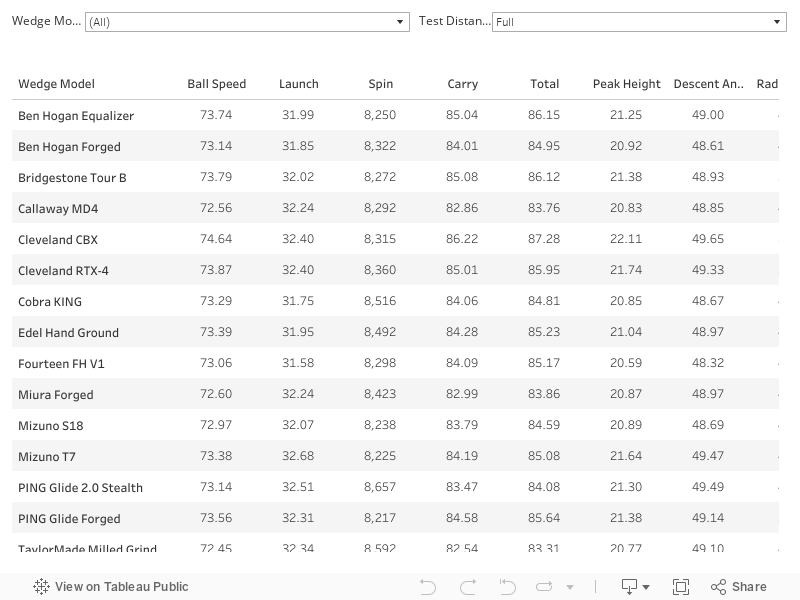
Most Wanted Wedge Data

The Importance of Choosing the Right Wedge

An often over-looked and supremely important part of what’s in your bag – wedges.  It’s inevitable that you’ll miss greens, even the best in the world do. The question is: do you have the tools to pull off those precarious shots around the green?  The high lofted clubs you carry in your bag can be a determining factor for whether or not you’re able to get up-and-down to save par.

The bottom line is that choosing the right wedges to compliment your game can help you shoot your best rounds, but how do you know what is truly right for you? There are a number of factors like loft, bounce, and sole grind that can have an impact on your performance out of varying lies.  The best way to ensure you have the right wedges is always to get fit. Let this test serve as a guide to help steer you in the right direction to better performance.

If you’re in the market for new wedges in 2018, this guide is for you.

Tech Trends

Wedge technology is a slow-changing environment – with very little room in which to work, manufacturers are doing everything they can to push the limits and improve performance. We identified three main tech trends that equipment manufacturers have gravitated followed in recent years: progressive center-of-gravity, updated groove technology, and progressive head shaping.

Progressive Center-of-Gravity –  Some manufacturers utilize what’s called a progressive center of gravity (CG). The location of what’s commonly referred to as the sweet spot changes based on the loft of the wedge – and in some cases, based on the sole grind of the wedge as well. In most, though not all cases, companies implementing a progressive CG design strategy offer lower centers of gravity in less lofted wedges (pitching and gap wedges) and the progressively raise it as loft increases. The goal of the types of designs is to optimizing the trajectory for each loft.

Groove Technology – Since the USGA Rule change in 2012, manufacturers have done everything possible to push the tolerance limits. Creating new technology to allow golfers to generate the most spin from both the fairway as well as the rough. While not a new trend, companies like PING with the Glide 2.0 and Callaway with the Mack Daddy 4 utilize an extra groove positioned close to the leading edge to increase spin rates.

Progressive groove depth has been a staple of most wedge lineups since the USGA implemented the new groove rule. In models like the Most Wanted PING Glide 2.0, grooves in the lower lofted wedges are deeper and thinner to optimize performance on straight-faced, full shots. In contrast, grooves in the higher lofted wedges are shallower and wider.

It should also be noted that many brands have begun to leverage wedge grooves in their set wedges (gap, sand, and lob). It offers a performance-driven solution for golfers who prefer their wedges look like their irons, but still want true wedge performance.

Product Spotlight – Mizuno S18


There are invariably products in every test that stand out, both regarding performance and the subjective feedback from our test pool. Among the products that didn’t hit the board, the Mizuno S18 was notable for its excellent, well-rounded performance. The S18 finished ranked 2nd overall in the test and finished in the top 3 for roughly 1/3 of our key metrics.

Feedback was overwhelmingly positive among the test group, with over half of the testers ranking this wedge among their top choices for looks and feel. Some testers preferred the larger head shape of this wedge over its counterpart, the T7. The S18 offers a compelling alternative to traditionally shaped wedge. Sitting somewhere between a Titleist SM7 and a Cleveland CBX, it’s more forgiving than the former without the bulk of the latter.

GIVEAWAY: The “Best Value” Rangefinder 2018!

Precision Pro NX7 PRO

Enter MyGolfSpy’s Giveaway!


Feedback from the Most Wanted Test Pool

Tester feedback is an integral part of every test we complete at MyGolfSpy. While it doesn’t play into our final results, subjective perceptions of any club no doubt affect the purchasing decisions of consumers. When we take subjective feedback, we poll testers on looks, feel and alignment at address.

Out of the 21 models tested, our test group rated both the Cleveland RTX-4 and Mizuno T7 (2017 Most Wanted Wedge) as the best for feel. Testers noted the exceptional balance of the RTX-4, citing its great feel on shots from all three distances tested.  The Cleveland RTX-4 was also rated the highest for looks at address.  The TaylorMade Milled Grind was also a tester favorite. Our golfers noted its quality feel on short chips and 40-yard pitch shots. Some testers commented positively on their ability to control the trajectory of the wedge at shorter distances.

Our Most Wanted winner, the PING Glide 2.0 Stealth was also highly rated by the pool. Many testers gravitated towards the matte black look, rating this wedge highly for looks. The test group also provided positive feedback on the shaping of the head, noting its traditional rounded look, yet modern feel with the finish. Despite the cast head, the testers rated this wedge highly on feel – this could be attributed to PING’s proprietary CTP (custom tuning port). One important thing to note is the Glide 2.0 Stealth is cast from a softer carbon steel than the original Glide 2.0.

Even in a test this size, testers will inevitably provide unanimous, or at least convincing, negative feedback on certain clubs. Such is the case for is the Tommy Armour Over N’ Out, the club we chose as the “Best Value Wedge” in our 2018 Test. Testers noted that the face was easily worn. During testing, we noticed it needed to be cleaned often, and bits of golf ball cover often were found in the grooves. The Ben Hogan Equalizer was also unpopular with testers. They described the feel of the wedge as “thin” and “clunky.” Others commented that the head was perhaps to compact, and didn’t sit properly at address.

While most all of the remaining wedges found themselves somewhere in the middle of the pack, several testers cited the Miura forged for exceptional feel and trajectory performance.

While feedback wasn’t universally polarized based on ability levels, it is true that some higher handicap testers preferred models like the Cleveland CBX, which features a cavity-back design that allows golfers to play clubs that perform like their cavity-back irons.  Higher-handicap testers also preferred the Tommy Armour Over N’ Out, noting that they believed the wider sole helped them get the ball in the air.

Buying Advice

Choosing the right wedge is a combination of preference, performance, and of course proper fitting.  There are some factors to consider when you’re getting fit for wedges:

  • Bounce – to ensure you give yourself to make the best chance to make solid contact, it’s necessary to match the bounce of the wedge to your typical angle of attack, as well as the conditions in which you typically play.  We tested mid-bounce options in our Most Wanted Test (bounces ranging from 10°-12°).
    • If you take a shallow or no divot, a low bounce option might be the way to go. A low bounce wedge might also be useful if you typically play firmer turf conditions.
    • If you have a neutral angle of attack, and typically play on normal turf (not too soft, not too firm), a mid-bounce wedge is a viable option.  It’s important to note that mid-bounce options are typically the most versatile – so if you play a variety of turf styles, consider mid-bounce for your next purchase.
    • If you have a steep angle of attack (digger), where you take large divots, or play soft turf – a high bounce option may suit you best.
    • To ensure you have a wedge for every situation, it’s not uncommon for golfers to blend high and low bounce wedges into the bag.
  • Gapping – One of the most important things to consider when purchasing wedges is proper gapping.  Whether you decide to carry two, three or four wedges, make sure that your loft gaps don’t leave any distance black holes. Many major retail outlets and independent club fitters offer a gap analysis to determine if you have all the shots covered.
  • Spin Isn’t Everything – We understand that for average golfers, there is something special about seeing a ball spin back on the green. While it might feel great to rip the cover off a ball and suck it back 20 feet, the reality is that most golfers don’t possess the trajectory and spin control that the pros do. When you’re choosing the right wedges for your game, consider more than just what gives you the highest spin. Instead, look for impact consistency and trajectory control — the more consistent your impact on the center of the face, the more predictable that ball will be. Consistency can go a long way towards lowering scores.


Wednesday, December 5, 2018

Golf Ugly Christmas

https://ift.tt/2PobCdM

Submitted December 05, 2018 at 04:26PM by DullService https://ift.tt/2zKsvud

TaylorMade Teases 2019 #ScrewFace Driver

In what surely must be the latest example of coincidence within the golf equipment world, on the same day that Callaway’s Epic Flash line of drivers landed on the USGA’s conforming clubs list, TaylorMade released a short teaser video for its upcoming 2019 drivers.

Promising that, on February 1st, #EverbodyGetsFaster (that’s the official hashtag), TaylorMade revealed the face of its new models. While you can be sure that Twist Face persists, 2019’s twist (I booed myself) is a pair of red screws positioned in the low heel and toe of the face. Isn’t that interesting?

Racecar wheels, jet engines, and some sort of flaming reaction. Oh my, that is fast.

Let’s be real, far too often golfers behave like fish. That is to say; we’re easily distracted by shiny objects and sometimes bite on things we shouldn’t. TaylorMade knows this, and so it also knows that doing something that hasn’t been done since the days of persimmon  – like putting big screws in the face of a driver – is sure to attract attention to its face technology in a year when face technology will be all the rage.

Behind the screws will be a story about faster, and more to the point, more consistent ball speed, across more of the face. That’s how you, me, and everyone else is going to get faster. TaylorMade will talk about how it made the face so fast, it needed the screws and other structures to help slow it down and bring it back under the USGA limit. Every brand has told a version of this story at one time or another, but in golf, everything old is perpetually new again. Along similar lines, TaylorMade will recycle a story from the Adams XTD driver and say that every face is individually inspected and measured to ensure that CT is at the USGA limit at multiple points.

Depending on your predilections, the screws might be cool, but I’d wager that what’s closer to reality is that whatever difference-making technology there is, it’s mostly out of sight. Inside the head, the face will feature variable thickness, goo-filled structures – pockets of sorts – which is how TaylorMade will say it can better control CT. The screws, not unlike Cobra’s Space Port, they’re the visible bits to raise awareness of what you can’t see. That’s my thinking on the subject anyway. I’m open to being proven wrong.

An updated track weighting system is also said to be part of the package.

The Next Big Thing or the Next Big Bust?

TaylorMade very well could be setting the trend with the next big thing, but I’m not without my concerns. Feedback from industry insiders and experts can be summed up in two words: Structural failure. What happens when a golfer hits the ball on the screws? No matter how far from center the screws may be, they’re going to get hit, and the thinking is that the screws may weaken the surrounding titanium and cause cracks. We’d wager TaylorMade has put the new design through its paces, but the same was probably said about the original M series drivers (crowns cracking), and several generations of face slot irons (slots splitting), so there is some legitimate quality control history with new TaylorMade technologies that should rightfully raise eyebrows.

It also remains to be seen what the weight penalty is for adding screws and goo to the face. It’s certainly possible that TaylorMade has made the technology weight-neutral, but at a time when everyone else is scrambling to remove weight from the face and push mass lower and deeper, it’s at least interesting that TaylorMade appears to be adding forward mass. Reality to be determined when we can get the new heads on our Auditor CG gauge, but one of the near-universal truths in golf equipment design is that structures bring with them mass penalties.

Finally, to the best of my knowledge, nobody has asked TaylorMade what they mean when they say at the limit. Technically that’s 239 microseconds, but with tolerances, it’s possible to push it a bit further. Even the most aggressive brands, however, tend to play in the low 240s. Much higher, even if you’re still below 257 microseconds, and the USGA is likely to issue warnings and start digging a bit deeper. Nobody wants that. Point being, while consistency across the face shouldn’t be downplayed, it needs to be made clear that you can’t measure your way to a ball speed breakthrough.

GIVEAWAY: The “Best Value” Rangefinder 2018!

Precision Pro NX7 PRO

Enter MyGolfSpy’s Giveaway!


It should go without saying that it’s a little early in the game to say whether or not the #ScrewFace (that one’s not official) technology works. The early performance reports on the new drivers (reportedly M5 and M6) have been universally excellent, with the M6 being the more noteworthy of two. Those without the proverbial skin in the game that we’ve heard from rates the TaylorMade stuff a touch higher than Callaway’s Epic Flash, which I suppose is a good sign for TaylorMade. Caveat emptor; early reviews are almost always positive. Actual reality will be determined once consumers get involved.

If nothing else, the early comparisons illustrate how myopic the industry tends to be with respect to the marketplace. It’s a reasonable assumption that the new gear from Callaway and TaylorMade is going to be good, but to talk about this in binary terms is silly. It’s by no stretch one or the other. As we discussed in our recent podcast, 2019 is shaping up to be the best year for drivers ever, and if the conversation in your head doesn’t include PING, Cobra, Mizuno, Srixon, Wilson, Titleist, PXG (and a qualified fitter), you’re doing yourself a disservice.

As we inch closer to the start of the buying season, my advice is this: Don’t be a fish. Shiny things don’t matter. What matters are mass properties and ball speed. Everything else is just a distraction, and it can be far too easy to lose sight of that when 95% of what passes for innovation in golf equipment is just clever marketing.