Get the Ultimate Golf Simulator Comparison Tool

Get the Ultimate Golf Simulator Comparison Tool

Tuesday, December 4, 2018

TPT Shafts: The Good, Bad and the Reality

The equipment portion of the golf industry is an often over-caffeinated, hype-filled cacophony blended with some real news, some fake news, and opinion-based facts masquerading as fact-based opinions.

Certain segments of the market are shadier than others, and there’s an argument to be made that graphite composite shafts is among the most dubious categories.

That’s all to say, it can be a real mess, and without a roadmap to navigate it all, consumers play right into the hands of OEMs pedaling new and improved product which plays on a consumer ego long been convinced that new and improved invariably leads to longer and straighter – or at the very least, somehow better.

Within this context, shaft newcomer TPT (Thin Ply Technology) merits a deeper dive as it presents a viable argument its offerings are legitimately different than every other shaft on the market. While the company line is that those differences make for a superior performing product, there are plenty of questions surrounding the durability of its $500 shafts.

During testing, the MyGolfSpy staff broke two TPT shafts (one in play and one during routine profiling), multiple failures were reported during forum testing at GolfWRX, and over the summer, there were frequent reports of tour players snapping TPT shafts.

The most notorious example happened during the first round of the Australian PGA Championship last week, John Senden’s prototype TPT shaft snapped during his swing on the par-5 9th hole. The video shows the shaft break toward the butt section of the shaft, which is where it seems a majority of the failures in TPT’s LKP model occur. It’s one thing when a shaft snaps on the range, but when it costs a professional strokes and ultimately money, it becomes a much larger issue.

Senden is far from alone. In the rare convergence of golf and baseball, Jason Day reportedly keeps his TPT shafts on a pitch count whereby he replaces it after a certain number of swings. I believe that might be an industry first. Rod Pampling, Patrick Reed, and others have had TPT shafts break on them at one time or another.

That said, with Vijay Singh’s victory at the season-ending Charles Schwab Cup Championship this November, TPT has a baker’s dozen of worldwide wins. Moreover, TPT’s technology is just as viable at the consumer level where players of all swing speeds are finding surprising amounts of increased distance while also decreasing dispersion, according to former tour player and current instructor, Jon Sinclair, who sits on TPT’s advisory staff.

So, is TPT the next coming of high-performance shafts or is the product simply structurally unsound? It might not be an either-or proposition.

HUMBLE BEGINNINGS

At the 2017 PGA Show, I met with Sebastian Sebayang (Director of TPT Golf) and Francois Mordasini (Chairman and Co-founder) at a small table on the concourse outside the main exhibit hall. It’s likely we could have pooled the entirety of our Twitter followership and not cracked triple digits. Literally and figuratively, TPT’s presence sat beyond the periphery of the market and other than its co-branding efforts with David Ledbetter, it was just another new company with a semi-interesting story – not unlike dozens of other companies looking to gain some traction at the industry’s annual meat market and hob knob.

Chiefly, what TPT claimed to offer was a technologically superior production process which could create the most consistent shafts in existence – a bold position for a company which stuck a $700 price tag on a shaft without a typical PGA Tour profile. TPT’s first shaft – which Lydia Ko bagged in 2016 before signing her equipment deal with PXG – offered a mid-launch/mid-spin profile geared toward players with moderate swing speeds. At the time, TPT promised it would deliver a beefier shaft in late 2017.

It was a faith-based business plan, built around a proprietary process a decade in the making. TPT’s cutting-edge robotic technology worked in Formula 1 racing and was a dominant force in the competitive sailing market. Success led TPT to look for opportunities in other areas. “I wanted to see if I could make a golf shaft,” Francois told me.

At a fundamental level, the only necessary question to ask of any new product is, “Is it better? Does it offer some segment of players a performance benefit which doesn’t exist without it?”

There’s plenty of redundancy in the shaft market, which is illustrated by the reminder one industry veteran offered me…” There are only so many bend profiles (in shafts)” The salient point being while OEMs like to highlight what are often minute differences in specs, design or material usage, shafts invariably fall into one of several bend profiles, and shafts with similar profiles offer largely similar performance.

Other than LA Golf Shafts impending fractional ownership model, players aren’t compensated for shaft usage, so if there’s an opportunity for a new company to make inroads without fronting a bunch of cash to gain tour exposure, this is it. That said, just because it’s possible doesn’t mean it’s likely. There is also the primary challenge of gaining validation in a retail fitting environment because giving away product to tour pros doesn’t pay the bills. It’s a delicate balance – one which requires a product to win on both the launch monitor and on the course – and even then, there has to be a coherent marketing approach which gets the product into players hands and on a fitter’s wall.

It’s an uphill battle in all directions, but it can’t account for the serendipity of current world #1, Justin Rose bagging a TPT shaft en route to three worldwide wins in late 2017, including WGC-HSBC Champions in China and Turkish Airlines Open in back-to-back weeks. Several months later, Jason Day picked up a win at the Farmers Insurance Open with TPT shafts in both his driver and 3-wood. Most recently, wins #11 and #12 came courtesy of Bryson DeChambeau at the Shriners Hospital for Children’s Open and Hyowon Park at the KPGA A+ Life Hyodam Jeju Open. Including Singh’s aforementioned win in early November, that’s 13 professional wins and counting in less than two years.

That’s a hell of a tagline for an infant company which jumped head-first into the deep end of the pool dominated by Fujikura, Mitsubishi-Chemical and Project X.

Equally impressive is TPT’s quick ascent into the premium custom fitting segment of the market. In 2018, TPT increased its number of authorized U.S fitters from 24 to 75, 39 of which came via an agreement between TPT and Club Champion to carry TPT’s full line of shafts in each of its retail locations.

Internationally, Sebayang reported a 400%+ increase in the number of authorized fitters, from 25 to 136. In total, TPT started 2018 with 49 authorized fitters and will finish with 211, a figure which will continue to increase incrementally based on TPT’s growth estimates.

TPT’s rapid surge into the premium shaft market is remarkable by any metric, and if there’s a single message, it’s that TPT can give players like Justin Rose, Bryson DeChambeau, Jason Day and Patrick Reed something which they may not get from any other OEM.

NOT ALL RAINBOWS & UNICORNS:

Growing pains are inevitable. It’s the reason hindsight has perfect vision, and final papers are preceded by rough drafts. That said, at a certain point pain can become indicative of a larger problem, one which merits further investigation.

Depending on who you ask, TPT’s first generation of shafts either break at a rate high enough to justify steering clear of the brand entirely or symbolize the kind of bumps in an otherwise smooth road that invariably arises when a fresh brand tries to disrupt the status quo. As usual, the truth is likely somewhere in between.

For its part, TPT claims it’s 2018 failure rate is .06%, the vast majority occurring with lower torque models aimed at higher swing-speed players.  At face value, the number shouldn’t raise concern, however; the context always matters. When a tour pro snaps a shaft in front of a range full of fellow pros, it becomes less about the single shaft and more about how many others saw it happen.

At least one major club manufacturer declined to move forward with adding TPT to its upgrade catalog after the shaft reportedly failed its quality control checks, while a tour rep for another company told MyGolfSpy that he won’t let his players near TPT product.

While there’s plenty of anecdotal evidence to suggest TPT shafts can offer performance benefits, many are taking a more cautious, wait and see approach while acknowledging the uniqueness of TPT’s process and what it could mean for the industry as a whole.

Hoyt McGarity, CEO of TrueSpec Golf, has some experience with the brand and has decided that until the durability issues are addressed, he’s sitting this one out. “We just broke so many of them,” McGarity told MyGolfSpy.

In this case “so many” is 9 or so shafts over several months, which again may not seem like a lot, but considering typical failure rates, the clientele with which McGarity tested TPT’s shafts and the environment in which the breakages occurred, it was a deal-breaker. Additionally, McGarity felt the ultimatum to carry all of TPT’s 16 different SKU’s was too big of an ask given the spotty track record.

That said, McGarity remains optimistic on TPT’s future because he sees what the product could become and by hiring credible industry veterans like Jeff Meyer as its Technical Director (30 years with Aldila and G Loomis) it’s clear TPT is working to find solutions.

GIVEAWAY: The “Best Value” Rangefinder 2018!

Precision Pro NX7 PRO

Enter MyGolfSpy’s Giveaway!


At roughly the same time, TPT named Jon Sinclair as its US-based Technical Advisor. Sinclair and his team work with dozens of PGA Tour and Web.com Tour professionals, utilizing a variety of cutting-edge technologies (e.g. GEARS, AMM 3D, 4D Motion) to study how player’s motion patterns are impacted by different shaft parameters (weight, torque, balance point, profile). Sinclair believes TPT’s technology could permanently alter the shaft landscape.

“The consistency is a game-changer,” Sinclair told me, though he notes it’s far from a finished product. “If there’s a problem, I’m very straight with them.” Part of Sinclair’s role as an advisor is to provide objective feedback even when it means confronting some brutal facts. While he’s all about optimizing performance for elite players, he understands consistent performance only matters if players trust the product.

Durability is often a sacrifice made when pushing the limits of performance, and if there’s a fatal flaw in TPT’s first generation of shafts, it’s that the company didn’t accurately assess how its shafts would hold up under a wide range of conditions and higher than typical swing speeds.

To its credit, Sebayang reports TPT has made changes both in material structure (improved resin and a new nearly weightless layer of material) and its automated processes, which should improve the durability of its shafts.

“What’s most important at the moment are our quality control tolerances (increased by 200%), which involves both the continued refinement of our automated shaft manufacturing software and our proprietary machinery. We’re also working with an engineering school in Switzerland to develop a new machine to improve quality control. It’s something we’re creating from the ground up to allow us to “see inside” each of the shafts we create after production to ensure that they are perfectly concentric and homogenous.” – Sebastian Sebayang

Nick Sherburne, co-founder of Club Champion, admits there are some advantages to being the only major premium club fitter currently offering TPT’s full slate of shafts, though the durability issues haven’t gone unnoticed. Because of the current price point ($500) it’s not a high-volume item, and Sherburne was reluctant to give TPT any particular praise beyond its status as “another one of our high-end vendors.” He also suggested TPT would be wise to find a more cohesive approach in educating potential consumers on its proprietary and unique in the golf industry manufacturing process.

REASON FOR INTRIGUE & SKEPTICISM

TPT is a proxy for the argument that, in spite of the tight boundaries within which the USGA requires OEMs to operate, opportunities for performance improvements still exist through materials and processes which weren’t originally intentioned for the golf space. With new possible answers, however, comes a new set of unknowns.

TPT’s proprietary Thin-Ply Technology is a prime example. Unlike the standard table rolling method, TPT’s automated process can independently control every shaft parameter and hold it to exacting tolerances. Theoretically, TPT could produce custom fit, one-off shafts for individual players based on specific swing characteristics. Because other OEMs don’t have the same technology, the product is difficult to reverse engineer which creates a quandary for competitors. In the short term, it’s convenient to pick the low hanging fruit of early breakages as evidence the technology is unproven and thus far, unreliable. After all, it’s unlikely Justin Rose would swap his TPT shaft for Mitsubishi’s Tensei Orange after three wins at the end of 2017 unless there were a serious problem.

It’s not unusual for new technology to be less than perfect out of the gate. The industry consensus, even among some of its competitors, is that TPT will eventually crack the durability problem.

If that happens sooner rather than later and more top players like DeChambeau put the shafts in play and start winning with them, then what?  If that becomes more the norm and if TPT follows through on its guarantee of added distance, improved accuracy and unrivaled consistency for any significant percentage of golfers, the story becomes far more compelling.

Until then we’re stuck in this equipment purgatory where product failures are a bit like Regan’s differentiation between a recession and a depression which paints the former as “where your neighbor loses his job” and the later as “when you lose yours.”

It’s a problem, the magnitude of which depends on how close the individual is to the source – that is, if it’s a problem at all.

So where does TPT sit with consumers? Give us your thoughts.


Monday, December 3, 2018

Why has Rory stalled at the majors in recent years?

Sure he's been competitive and had chances but he has been unable to convert in a major since 2014. Just looking for others thoughts on why this is. Mental block? Or maybe the wealth of young talent?


Submitted December 03, 2018 at 01:19PM by CharacterExpression https://ift.tt/2Ef4M9s

Hannah McCook: Diabetic Scottish golfer uses Steve Redgrave as inspiration

https://ift.tt/2zC7RfS

Submitted December 03, 2018 at 01:19PM by haveyouseenmywetsuit https://ift.tt/2SqiMQU

QBE Shootout - December 7–9

QBE Shootout - Tiburón Golf Club at The Ritz-Carlton Golf Resort - Naples, Florida

7,385 yards - Par 72

Event Website

Course Guide

Course Website

Past 5 Winners:

2018: Sean O’Hair & Steve Stricker
2017: Harris English & Matt Kuchar
2016: Jason Dufner & Brandt Snedeker
2015: Jason Day & Cameron Tringale
2014: Harris English & Matt Kuchar

Player List Click here


Submitted December 03, 2018 at 01:24PM by barkhorse https://ift.tt/2SsmSYK

First Look – 2019 Callaway Epic Flash & Epic Flash Sub Zero Drivers

Callaway Epic Flash

Not that a few pics haven’t already leaked via Instagram, but you know you’re inching closer to a new release when the USGA greenlights a new driver. Given that it’s been nearly a year since the launch of Rogue, I think just about everyone who even loosely follows the golf equipment industry could have predicted that something new was in the Callaway pipeline, and so here you go.

For 2019 Callaway will offer up the Epic Flash and Epic Flash Sub Zero drivers. And while I don’t have any definitive proof – at least not from the USGA – I’m going to go ahead and assume that an Epic Flash Draw will follow, and I’m not ruling out an Epic Flash Star either, though that 4th one is less certain.

Epic Flash Sub Zero version 1

Callaway hasn’t shared its technology story with me just yet, but the most obvious point to share is that both the standard and Sub Zero models share a rear-placed, multi-position, sliding weight system. We’re all familiar with draw vs. fade settings by now, but it’s also worth pointing out that these types of systems also allow you to more closely align the CG position with your typical impact position. If you tend to hit the ball a bit on the toe, the fade position might generate more ball speed. The same holds true for the draw position for golfers who favor the heel a bit.

As you’d expect all models feature Callaway’s now signature Jailbreak technology, while the Sub Zero models are again differentiated by a forwardly placed weight. This time around, the Sub Zero doesn’t appear to offer any forward/back swap-ability, though the design certainly suggests that additional weights will be available for swing weight and other tuning purposes.

As has become typical for Callaway, the USGA has cleared 3 version. It’s a safe assumption that two of them will be for tour use only, so let’s not all freak out about too many models and whatnot.

Epic Flash Sub Zero version 2

Pricing and Availability

Given recent trends, I would expect Callaway to start teasing Epic Flash in the coming weeks via its social media channels with the official information dropping in early January. I’d wager the actual release date will be sometime after the PGA Show, so let’s call it late January to early February. Finally, while I don’t have confirmation from Callaway, you can expect the Epic Flash series to retail for over $500. In fact, I think $550 is a safe assumption. If that sounds insane, bear in mind that the trends you saw with Titleist and Wilson will continue. Average retail prices are going to be up industry-wide for 2019. We expect TaylorMade will also break the $500 barrier with at least one of its 2019 models.

Epic Flash Sub Zero version 3

More information as it becomes available.


Stage Set for the PGA of Canada’s Final Championship of ‘18

https://ift.tt/2AL2T00

Submitted December 03, 2018 at 08:18AM by BanksKnowsBest https://ift.tt/2U80i9i

Friday, November 30, 2018

I had to make fun of Sam Burns’ new Callaway video

https://ift.tt/2zy2dv5

Submitted November 29, 2018 at 09:28PM by Internet_Indigestion https://ift.tt/2PaxVUe

Thursday, November 29, 2018

MyGolfSpy Insider Podcast Episode 3: The Best Year for Drivers Ever?

Will 2019 be the best year for drivers ever?

We think so. Golfers in the market for a new driver will have more choices than ever and that’s exciting. In the golf industry, however, nobody is up without somebody else going down. Which brands are poised to gain ground in the market and which risk dipping a bit?

Keeping it in-house for this episode, MyGolfSpy owner, Adam Beach, and Editor, Tony Covey, discuss how the market is shaping up and make their predictions for a 2019 Most Wanted Winner.

Have a listen.


The Match: Pointless yet Entertaining, an Indicator of the Future?

https://ift.tt/2Q1sWun

Submitted November 28, 2018 at 08:25PM by namrog99 https://ift.tt/2RmBQPE

Wednesday, November 28, 2018

First Look: Wilson Staff Prototype Blade

Credit to Golf.com‘s Jonathan Wall for being the first to spot what appears to be new Wilson Prototype blades in Gary Woodland’s bag in the Bahamas.

Whoah…

A few hours later, Wilson Staff tour pro Brendan Steele posted a Tweet of his own on the new irons, noting that he was part of the design team. The cat is officially out of the bag.

So new blades and Gary Woodland? What in the name of Gene Sarazen is going on here?

Blade Prototypes

Wilson’s current blade, the FG Tour 100, was released in 2014 as part of Wilson Staff’s 100th anniversary as a golf brand. This new prototype features a few similarities to the Tour 100, including the same bore-through hosel, but the muscle back is a little simpler looking and it appears to be more toe-weighted. We’ve reached out to Wilson for more information, and the company confirms they’ve been waiting for a chance to test the new prototypes with its Tour staff, specifically Brendan Steele.

GIVEAWAY: The “Best Value” Rangefinder 2018!

Precision Pro NX7 PRO

Enter MyGolfSpy’s Giveaway!


It’s shaping up to be a busy fall for Wilson Staff. We’ve been through Driver vs. Driver, and the introduction of Cortex, and a replacement for the two-year-old D300 irons and metalwoods is due by January. Wilson’s FG Tour V6 irons are also two years old, and considering Wilson’s two-year product cycle, MyGolfSpy’s 2017 Most Wanted Player’s Iron is also due for an upgrade.

The other part of the story, however, is what’s up with Gary Woodland?

Partial Free Agent

According to Wall’s article, Woodland is an equipment free-agent, sort of. After leaving Callaway at the end of 2015, he signed a metal-woods only deal with TaylorMade and has been using Titleist irons and wedges without a deal. Woodland will apparently be gaming the new Wilson blades, as well as a Wilson FG Tour V4 utility iron, at this week’s Hero World Challenge.

For its part, Wilson says Woodland expressed some interest in a new blade, and the company was happy to supply him with product – as they would for any Tour player – for personal testing and evaluation. The fact Woodland is putting the irons in play this week in the Bahamas indicates a level of interest a few steps beyond “personal testing.”

The three-time PGA tour winner is currently 32nd in the Official World Golf Rankings, and it remains to be seen if this week represents an equipment trial on his part or a prelude to a new equipment deal with Wilson Staff. If that were to happen, Woodland would be Wilson’s highest ranking Tour pro. Brendan Steele, Kevin Streelman and Padraig Harrington are currently ranked 103rd, 176th, and 187th respectively.


Pro golfer Austin Hughes blames Air Canada for temporarily losing clubs, hurting his chance at the European Tour

https://ift.tt/2SdWLEL

Submitted November 28, 2018 at 06:54AM by BanksKnowsBest https://ift.tt/2TN3nLX

Tuesday, November 27, 2018

2018 MOST WANTED SUPER GAME IMPROVEMENT IRON

INDEPENDENT & UNBIASED

MyGolfSpy accepts $0 advertising dollars from any of the major golf manufacturers. We believe in always putting #ConsumerFirst.


120

Hours Researched

5,049

Shots Hit

9

Products Considered

36.6 Million

Readers

2018 Most Wanted Super Game Improvement Iron Rankings

Cleveland Launcher HB

Cleveland Launcher HB

Most Wanted Super Game Improvement Iron

Distance Rank
7th
Accuracy Rank
3rd
Strokes Gained vs. Avg. Rank
1st
1

Shop & Support

When you shop online consider using our special link. It helps support this site and other golfers around the world. #ConsumerFirst

Buy
Trade In/Up

What We Liked

Most Wanted Super Game Improvement Iron and Most Accurate Super Game Improvement Iron 2018

The Cleveland Launcher HB produced the highest strokes gained value, tightest radial distance, and had the smallest shot area among the short and mid-irons tested.

If you’re looking for a set of irons that achieves maximum forgiveness and accuracy, consider the Launcher HB.


Pros

  • Best overall Super Game Improvement iron of 2018
  • Extremely accurate across the entirety of the test group
  • Tightest results for both shot area and radial distance
  • Highest Strokes Gained average

Cons

  • Not among the longest, ranking in the bottom third for total distance
Callaway Rogue X

Callaway Rogue X

Best Super Game Improvement Iron for Distance

Distance Rank
1st
Accuracy Rank
9th
Strokes Gained vs. Avg. Rank
8th

Shop & Support

When you shop online consider using our special link. It helps support this site and other golfers around the world. #ConsumerFirst

Buy
Trade In/Up

What We Liked

A favorite among the test group, the Callaway Rogue X iron model produced the longest distances for long, middle, and short irons.

While it struggled in some areas, testers provided extremely positive feedback for the Rogue X for its distance.

If you are looking for pure distance irons, consider the Rogue X


Pros

  • Ranked 1st in total yards across short, mid and long irons
  • Ranked 4th for strokes gained among long irons

Cons

  • Ranked at the bottom for shot area and radial distance at each test distance.
  • Ranked at or near the bottom for carry consistency (a measure of forgiveness)

About This Test

All testing was conducted inside our fully independent test facility located in Yorktown, Virginia. All testers used Bridgestone Tour B-RX golf balls for consistency and to reduce test variables. Ball and head data were collected using Foresight Sports GCQuad launch monitors.

  • SHOTS HIT: 5,049
  • DATA POINTS:  348,381
  • TIME: 120 hours
  • TESTERS: 20
  • HANDICAP RANGE: 4 – 17
  • AGE RANGE: 29 – 83
  • DRIVER SWING SPEED RANGE: 70 – 99 mph
  • IRONS TESTED: Long, Mid and Short iron from each model

Field Notes

This section details equipment specifications and any outliers that might be present in that data.

  • Models tested included a short iron, mid iron, and long iron from each set.  All clubs tested were stock off the rack – in some cases, the stock long-iron in the set was a hybrid.
  • A tremendous loft discrepancy exists within the Super Game Improvement category. Measured lofts of the long-iron ranged from 21° – 25°; measured lofts of the mid-iron ranged from 26.5° – 31.5°; measured lofts of the short-iron ranged from 41° – 45.25°.
  • In all three cases, the Callaway Rogue X was the strongest lofted club measured, which likely explains its distance advantage. There is a strong correlation between loft and distance.
  • Measured lengths of the long-iron ranged from 36.75″ – 39.5″; measured lengths of the mid-iron ranged from 36.75″ – 37.25″; measured lengths of the short-iron ranged from 35.25″-36.75″
  • While lie angle was dynamic through the set, the Cobra F MAX measured identically in length and swingweight throughout the set.
  • Four of the models tested contained stock steel shafts; the remaining five contained lightweight graphite.

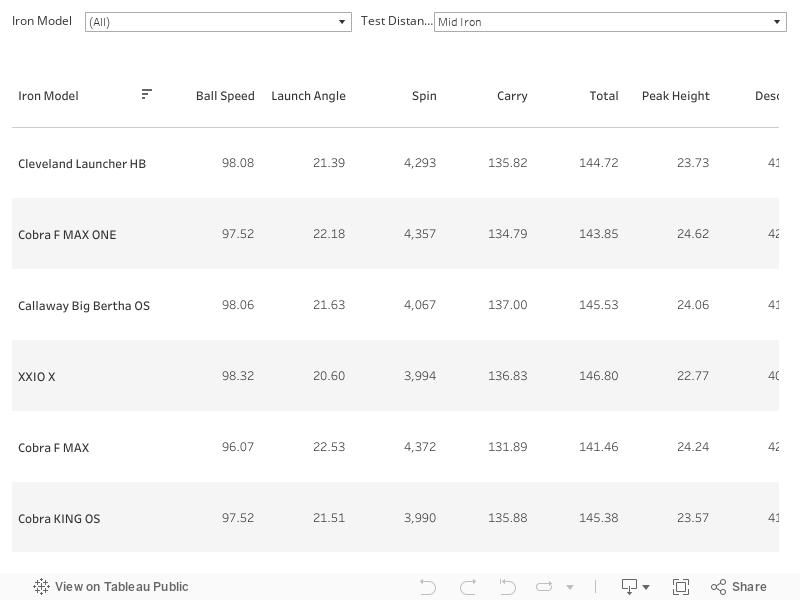
Most Wanted Super Game Improvement Iron Data

Why you should consider SGI Irons

If you’re in the market for new irons, it’s essential you choose the right type for your game. This game is difficult enough, and most golfers could use all the help we can get. Inherent in the Super Game Improvement designs is improved performance on off-center hits. Bigger heads, wider soles, and larger faces help provide maximum forgiveness while maintaining, and in some cases, increasing distance relative to other design categories (GI, players cavity-back, etc.).

Are Super Game Improvement irons right for you? Among the best-selling in the marketplace, this category should appeal to a wide variety of golfers. Perhaps you’re a seasoned veteran to the game, but over the years you’ve lost the distance you once had. If you struggle to get the ball in the air, SGI irons, with their light shafts and high-launch profiles may be right for you (provided you can manage the stronger lofts).

Distance and forgiveness, however, invariably come at a price. Inevitably, you’ll sacrifice workability and versatility, so it’s important to determine what aspects of performance are most important to you and choose your irons accordingly.

Tech Trends

Super Game Improvement irons are a good fit for many golfers. While these aren’t the compact, butter-knife blades most of us wish we could play, the category is packed with technology packed to help golfers seeking extra distance and added forgiveness.

As you’ve likely come to expect, stock lofts for SGI clubs are stronger than what you would find in other iron categories. The Callaway Rogue X is a bit of an outlier at 26.5°, the weakest lofted 7-iron we measured was 31.5°. To put that into perspective, the strongest lofted 7-iron in our Players Irons Test was 32° while the strongest lofted Players Distance 7-iron came in at 30°.  Moral of the story, lofts are getting stronger each year, and nowhere are they stronger than in the SGI category. Technology is allowing engineers to build clubs that launch higher and fly farther than ever, and stronger lofts are an essential part of the distance equation.

To mitigate the stronger lofts and promote higher launch, lightweight shafts are becoming increasingly common within the category. Shaft weights in this test ranged from 49-grams for graphite to 80-grams for steel. While lighter weight shafts can help produce higher head speeds, higher launch, and more distance, they can also create control issues for higher swing speed or faster tempo golfers.

Bigger bodies and specifically wider soles are common to most SGI designs, with the Cleveland Launcher HB offering the widest of this group. The wide sole promotes increased dynamic loft and helps prevent digging when you hit the big ball before the little ball. Ultimately, it makes for a more-forgiving clubs, but you’ll lose a bit of the versatility and workability that you would get from a more compact design.

GIVEAWAY: Titleist Driver + Fitting!

TITLEIST TS2 or TS3

Enter MyGolfSpy’s Giveaway!


Product Spotlight – Cobra F MAX ONE

Although not our best overall, the single-length Cobra F MAX ONE was rated just below the Cleveland HB. Aside from total distance, the F MAX ONE ranked either 1st or 2nd in every one of our key metrics (shot area, strokes gained, carry consistency, and radial distance ) for both the long and mid-irons.

Shorter distance with the long irons is to be expected, and could likely be overcome with a ONE Length Hybrid or Utility. The only negative we observed was with the PW, where some testers struggled to control distance with a longer than standard club. Testers told us the felt the club was more difficult to use attempting to hit it to shorter distances, though we believe this could be overcome with practice. Several testers (particularly the highest handicappers) said they preferred the consistent shaft length.

It is interesting to note that the FMAX ONE length is not a strong seller relative to Cobra’s other ONE Length offerings. That seems strange given that ONE Length seems particularly well-suited for the SGI category. Overall, the FMAX ONE was a strong performer and a favorite among testers. If you have any inclinations towards moving to single length irons, the FMAX ONE most certainly warrants consideration.

GIVEAWAY: Titleist Driver + Fitting!

TITLEIST TS2 or TS3

Enter MyGolfSpy’s Giveaway!


Feedback from the Most Wanted Test Pool

The Cleveland HB, our 2018 Most Wanted Super Game Improvement Iron Winner, despite its rather remarkable performance among the irons tested, received mixed feedback from the test group. As you may expect, the slower swinging, higher handicap testers preferred this model over most of the irons tested. The extra-wide sole and deep center of gravity help the testers launch the ball high, but the faster swing speed players complained that the club felt too light and whippy. Cleveland went to extra lengths to improve the sound and feel of the club with technology like internal rib construction. There’s some anecdotal evidence that it worked as several testers said they thought it was the best feeling iron in the test.

One of the most favored clubs in the entirety of the test for both feel and address position is the Cobra KING Oversize. The KING OS was rated in the upper echelon by our testers, though performance wasn’t stellar. Some testers enjoyed the oversized head shape, noting the “big face” and score lines that help the golfer line the ball up in the center of the clubface.  Many testers submitted positive feedback regarding the overall weight of the club, saying that it felt balanced across each iron they tested.

One of the top performers in the test, the Cobra F MAX ONE was well accepted among the test group. The higher handicap golfers preferred the shorter length long irons, rating the club as one of their favorites. Some testers noted they had no trouble getting the ball in the air despite the long iron being shorter than what they’re used to playing. The Cobra F MAX ONE was also tester favorite in the feel category. Perhaps interesting is the tester’s response to the variable length FMAX. Where the feel was rated highly overall, several testers weren’t fans of the oversized grips, calling them bulky, leading some to feel like they were losing control of the club.

The Callaway Big Bertha Oversize was one of few clubs in the test to receive almost unanimously negative feedback.  Many testers complained that the clubs felt somewhat “thin” and lacked a soft, solid feel. The test group disliked the chunky, short blade look of the iron and some complained that they had trouble getting the long iron up in the air. It’s worth mentioning that Callaway has just released a replacement to the Big Bertha OS (2018 Big Bertha). The new model significantly improves feel, while offering the requisite promises for improved performance in other areas as well.

Buying Advice

Choosing the right irons ultimately is determined by what you need to improve your game. Are you looking to maximize distance, or increase accuracy?  For most, the best iron is the one that offers a combination of distance, accuracy, and forgiveness.

Here are some factors you should consider:

  • The Shaft –  The age old debate of graphite vs. steel leaves the one of golf’s biggest questions unanswered, when do I switch to graphite?  The best answer comes when you work with a competent fitter. No two swings are alike, and that means that not everyone fits into the same box. Depending swing speed, tempo, angle of attack, and other factors, graphite shafts may or may not be the best fit. The clubs we tested have both stock graphite and steel, and the weight of the shaft will ultimately have an affect on your swing speed. Higher swing speed or aggressive golfers shouldn’t dismiss the SGI category entirely. When paired with a shaft better suited to your swing (often stiffer and heavier), SGI irons can deliver tremendous performance, even for those outside the traditional demographic.
  • Hybrids or Traditional Heads – While stronger lofts have increased distance, they often make it difficult for golfers, particularly slower swing players, to get their long irons airborne. If you struggle to hit SGI long irons high, consider replacing them with a hybrid. Many of the sets tested either come stock with hybrids or provide a hybrid-iron combo set options. If you’re still struggling with launch into your middle irons, consider lower center-of-gravity, wide sole options like the Cleveland Launcher HB. Finally, keep in mind that there’s no rule against bending an SGI set a degree or two weak if you need help getting the ball in the air. You’ll lose a bit of distance for it, but you’ll land softer into greens and likely have more control overall.
  • Set Make-Up – Along similar lines, something we often see at the testing facility is golfers coming in with a bag of clubs put together without any real purpose or intention. We see 3 and 4-irons in the bags of golfers who can’t hit them. Sometimes we find wedges that never get used. When you’re purchasing your next set of clubs, make sure you’re choosing irons that allow you to hit every shot you’ll face on the golf course. If that means pairing long-iron-replacing hybrids with traditional short irons, so be it.


Monday, November 26, 2018

Hero World Challenge - November 29 – December 2

Hero World Challenge - Albany Championship Golf Course - New Providence, Bahamas

7,302 yards - Par 72

Event Website

Course Guide

Course Website

Past 5 Winners:

2018: Rickie Fowler
2017: Hideki Matsuyama
2016: Bubba Watson
2015: Jordan Spieth
2014: Zach Johnson

Player List Click here


Submitted November 26, 2018 at 01:46PM by barkhorse https://ift.tt/2SfJzzk